
SRMU
Helping a streaming memory adapt to change without letting repeated observations dominate.
A memory that stays useful as observations arrive
The Sequential Relevance Memory Unit (SRMU) is an update rule for high-dimensional vector memories. It reduces the influence of repeated information while allowing the memory to adapt when observations change.
What
A rule for updating a vector memory as observations arrive, using what the memory already represents to control each new contribution.
Why
A useful memory should track change without letting repeated observations overwhelm information about things seen less often.
How
Fade earlier contributions, retrieve what is stored for the incoming key, then use its similarity to the new observation to scale the update.
What’s next
Can the same idea help spatial memories adapt as places change? Explore relevance-gated updates for spatial memory →
An example: remembering device health
Imagine monitoring several devices. One reports its health often; another is observed only occasionally. The goal is to remember the current state of all devices, even though each new observation describes just one.
A vector memory stores each device’s identity and health as an association in a shared vector. Adding every report equally can let a frequently observed device dominate the memory. If that device’s health changes, its old reports also remain mixed in.
SRMU compares a new report with the value already represented for that device. A close match receives a small update; a different value receives a larger one. Decay gradually weakens previous contributions so the memory can follow changes over time.
How the update works
In vector symbolic architectures, a key identifies an entity, such as a device, and a value describes its state. Binding combines them into an association; adding associations builds a shared memory. Querying with a key retrieves an approximate value.
From observation to comparison to updated memory
-
1. Observe
Bind the device’s key to its observed value to form one association.
-
2. Compare
Fade the memory by γ, retrieve what it holds for this key, and measure how closely it matches the incoming value.
-
3. Update
Add the association scaled by w = 1 − s. A close match adds little; a surprise adds a lot.
The updated memory becomes the starting point for the next observation.
- t = 1 A · healthy w ≈ 1.0 New device: nothing stored yet, so the full association is added.
- t = 2 A · healthy w ≈ 0.1 Repeat: already represented, so it barely reinforces the memory.
- t = 3 B · warning w ≈ 1.0 Rarely seen device: gets a full update, not drowned out by A.
- t = 4 A · faulty w ≈ 0.9 Changed state: poor match with the stored value, so a large update.
Inside the memory unit
The full diagram shows how these paths meet. The persistence parameter γ controls decay: smaller values retain less of the past, while γ = 1 preserves the prior memory. The relevance weight w = 1 − s controls how strongly the incoming association is added, where s is its similarity to the retrieved value.
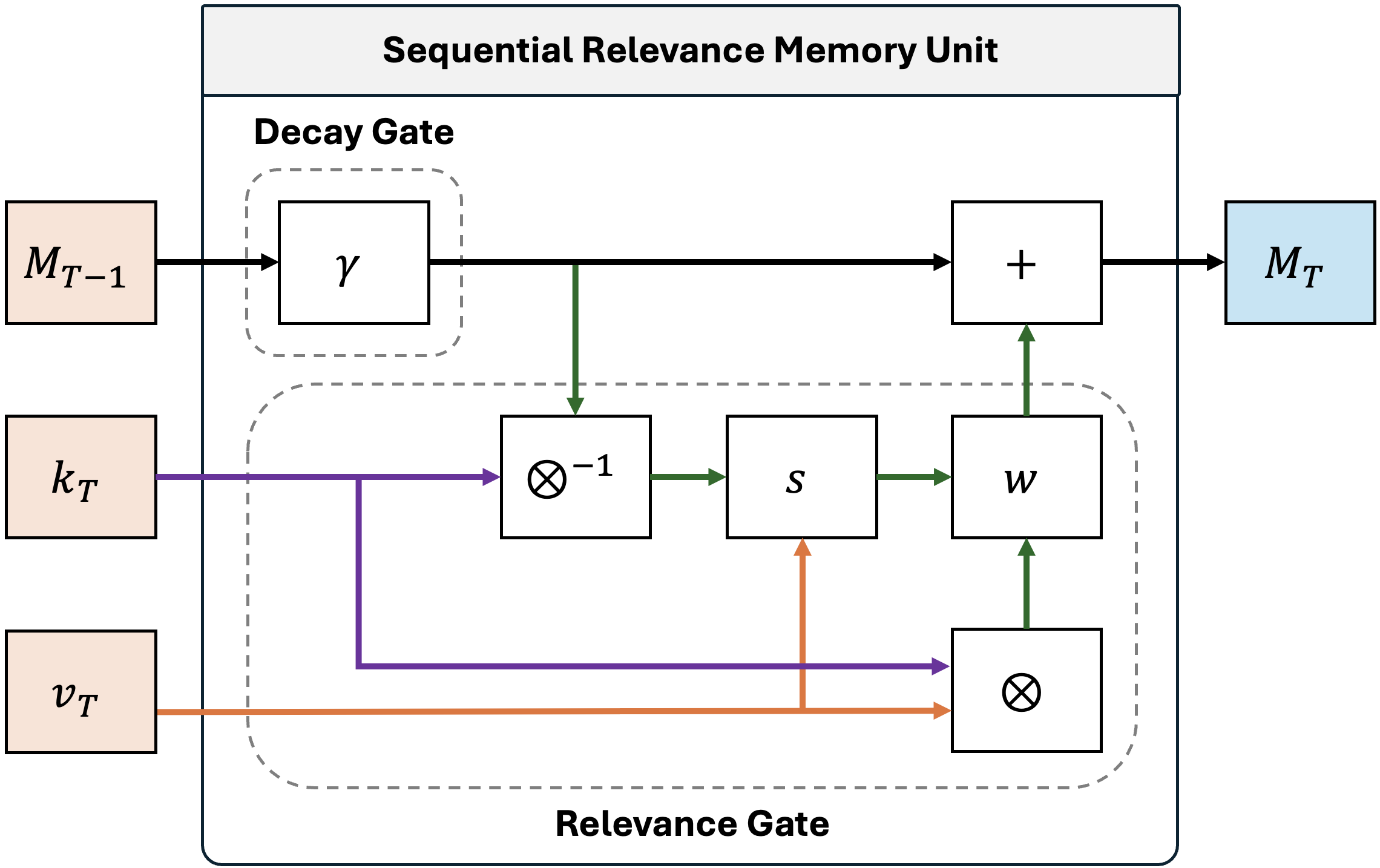
The two controls serve different purposes: decay reduces the influence of the past, while the relevance gate limits reinforcement of observations that already match the memory. The gate acts when information is stored, so it can complement methods that clean up estimates during retrieval.
The update rule and diagram notation
Let M be the previous memory, k the incoming key, and v the incoming value:
- Decay: M̃ = γM.
- Retrieve: v̂ = M̃ ⊗⁻¹ k.
- Compare: s = |⟨v̂, v⟩| / (‖v̂‖ ‖v‖); set s = 0 if either norm is zero.
- Weight and add: w = 1 − s, then M′ = M̃ + w(k ⊗ v).
Here, ⊗ binds a key and value, and ⊗⁻¹ unbinds a key to retrieve its value. The published implementation uses complex-valued Fourier Holographic Reduced Representations (FHRR), with the Hermitian inner product in the similarity calculation. Unbinding is elementwise multiplication by the complex conjugate of the key.
The weight measures agreement with the retrieved value; it is not an independent estimate of whether an observation is correct. The paper gives the full formulation in Section 5 and Algorithm 1.
What the experiments show
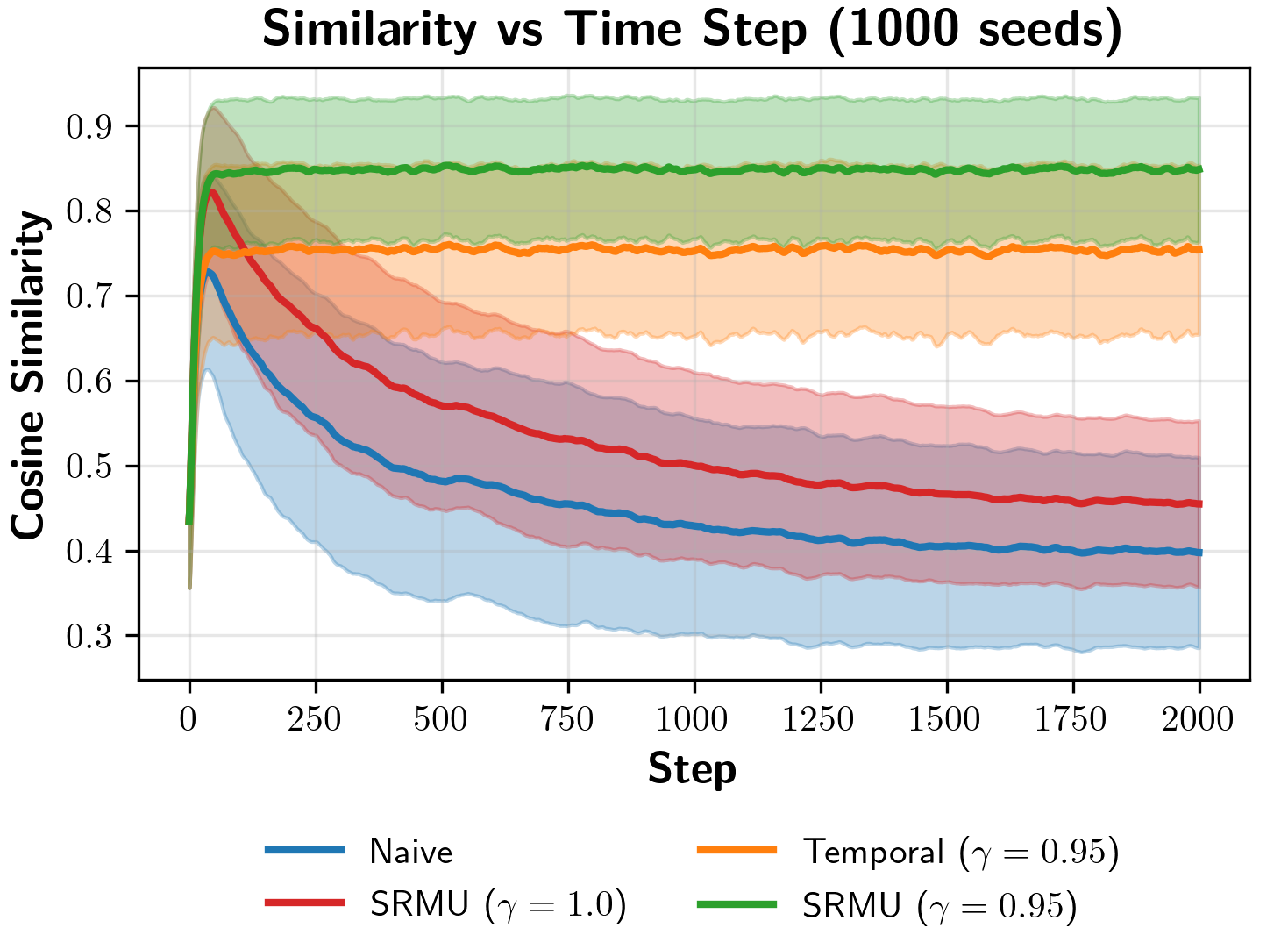
The strongest result comes from the experiment combining uneven sampling and changing states. At the same decay setting (γ = 0.95), SRMU increased similarity to the current ground-truth memory from 0.755 to 0.850: a 12.6% relative improvement over decay alone.
What was tested
The synthetic monitoring task uses five devices, five possible health states, and 256-dimensional vectors. Only one device is observed per timestep, with a 5% chance of observation noise. Three experiments isolate uneven sampling, gradual state changes, and their combination with occasional abrupt changes. The plots report 1,000 trials.
Cosine similarity measures how closely the learned memory aligns with a ground-truth vector encoding the current state of every device. Higher is better. Memory-vector magnitude measures the norm of the accumulated vector and is interpreted alongside similarity.
Combined-experiment comparison
| Update rule | Cosine similarity ↑ | Memory-vector magnitude |
|---|---|---|
| Add every observation | 0.397 | 9,337.07 |
| SRMU without decay (γ = 1) | 0.455 | 5,670.31 |
| Temporal decay alone (γ = 0.95) | 0.755 | 159.26 |
| SRMU with decay (γ = 0.95) | 0.850 | 74.01 |
Source: Table 2 in the paper. SRMU with decay also reduces vector magnitude by 53.5% compared with decay alone. Together with better alignment, this indicates less redundant accumulation. All methods use the same vector dimensionality; this result does not measure a reduction in storage bytes.
The other experiments clarify when each control helps. With uneven sampling and fixed states, SRMU without decay has the highest similarity (0.942). When states drift, SRMU with decay performs best (0.907). Decay is useful when the state changes, but can weaken useful information when it remains valid.
Scope and limitations
The evidence comes from a small synthetic state-tracking task. Larger sensing systems, spatial maps, and neuromorphic hardware remain to be evaluated. The persistence parameter still sets a tradeoff: stronger decay removes old contributions faster but can also weaken useful associations that are rarely observed.
SRMU controls how observations enter memory; it does not guarantee that a new observation is accurate or that retrieval is exact. Formal capacity and interference analysis, larger-scale evaluations, and efficient neuromorphic implementations are directions identified in the paper.
Connection to spatial memory
VSA-OGM studies how to encode spatial observations in vector memory and query them to reconstruct a map. SRMU suggests a next question: can that memory stay representative when some places are observed repeatedly and others change between visits?
In a spatial application, a key could represent a location and a value could describe occupancy. Repeatedly seeing the same occupied location should add less reinforcement, while observing a change at that location should have more influence. Decay would reduce the persistence of earlier observations.
The next step is to test whether this improves map updates while preserving useful information about rarely visited places. This is a proposed application; the published SRMU experiments evaluate device-state tracking.
My contribution
I developed the idea, designed and implemented the method, ran the experiments, analyzed the results, and wrote the paper. The paper was coauthored with Andrew Capodieci, David Gorsich, and Maryam Parsa and published at ICONS 2026.
Paper and code
SRMU: Relevance-Gated Updates for Streaming Hyperdimensional Memories. International Conference on Neuromorphic Systems (ICONS), 2026.
Code: The repository link will be added here when it is ready.
Read the paper on this page
Published version by Shay Snyder, Andrew Capodieci, David Gorsich, and Maryam Parsa. Reproduced unchanged under CC BY 4.0.
Cite this work
@inproceedings{snyder2026srmu,
  title     = {SRMU: Relevance-Gated Updates for Streaming Hyperdimensional Memories},
  author    = {Snyder, Shay and Capodieci, Andrew and Gorsich, David and Parsa, Maryam},
  booktitle = {International Conference on Neuromorphic Systems (ICONS)},
  year      = {2026},
  doi       = {10.1145/3822454.3822487}
}